

Demographer Jan Latten on declining birth rates and what they mean for the baby products industry
The decline in births is not a temporary dip, but the result of a fundamental change in our society. According to demographer Jan Latten, young people still want to have children, but housing shortages, economic uncertainty and changing relationships are making it increasingly difficult to fulfil that desire. What does this mean for an industry that depends on young families?
Who is Jan Latten?
Jan Latten is Professor Emeritus of Social Demography at the University of Amsterdam and former Chief Demographer at Statistics Netherlands (CBS). For decades, he has researched population trends, family formation, housing, migration and societal developments. Today, he is a speaker, author and sought-after commentator on demographic trends.
The number of babies born in the Netherlands each year has been declining for years. For the baby products industry, this is not an abstract statistic, but a development with tangible consequences. Fewer births ultimately mean less demand for pushchairs, car seats, nursery furniture and other baby products. Yet the birth rate tells only part of the story.
‘It’s not that young people no longer want children,’ says Latten. ‘They still do, but it is becoming increasingly difficult to start a family at the right time.’
A historically unique development
According to Latten, the current situation is historically exceptional. For centuries, children were essential to sustaining a society. Populations only declined during wars, epidemics or famines. ‘For the first time in history, we are now seeing populations shrink naturally. There are simply too few children being born to keep the next generation the same size.’
The Netherlands is not alone in this. Birth rates across almost all of Western Europe are below the so-called replacement level, meaning that each generation is smaller than the one before it. ‘That is unique. Yet public awareness of this development still seems limited. I expect that to change over the coming years.’

Net reproduction rate
The average number of daughters that would be born to a group of women if certain age-specific fertility and mortality rates applied. The net reproduction rate indicates the direction in which the future population will develop based on the birth and mortality rates of women during the period under consideration. If this figure remains above one over a long period, the population will eventually increase; if it remains below one, the population will decrease. International migration of women is not taken into account.
‘Young people still want children. The problem is that it is becoming increasingly difficult for them to fulfil that desire.’
The desire to have children is still there
According to Latten, the idea that young people no longer want children is a persistent misconception. ‘If you ask people in their early twenties whether they want children, around 80% immediately say “yes”. The desired number of children is still around two.’ This is consistent with recent research conducted in Denmark. The desire to have children has barely changed, but reality has. ‘The actual fertility rate is now around 1.4 to 1.5 children per woman. So there is a huge gap between what people would like and what ultimately happens.’ According to Latten, that gap is one of the most important societal issues of our time.
Why are young people postponing parenthood?
The causes are varied and reinforce one another, he explains. Young people spend longer in education, focus on building their careers first and take more time to find the right partner.‘In the past, the path was much clearer. Now you have to make all the choices yourself: which education, which job, which partner and where you want to live. That gives you freedom, but it also creates choice overload.’ Relationships, too, have become less of a given. ‘Even young couples regularly question whether they are truly right for each other. Dating apps create the impression that there is always someone else – perhaps someone better – available.’ As a result, starting a family is increasingly postponed. When is the right time? First a permanent job? First a home of your own? More financial security? First knowing whether the relationship will last? ‘All those questions cause people to wait.’
The housing market as a major obstacle
Latten sees the housing market as another major reason why people postpone having children. ‘Many young couples would like to start a family, but simply do not have a suitable home.’ Highly educated people in their thirties, in particular, are struggling in the major cities. ‘For many first-time buyers, purchasing a home there is simply out of reach. As a result, you see young families moving to towns outside the major cities, such as Woerden or Berkel en Rodenrijs. These are becoming the new family-oriented communities.’ According to Latten, this illustrates just how closely housing and family formation are connected. ‘A suitable home quite literally provides the foundation for starting a family.’
Uncertainty is mounting
Alongside the housing market, economic developments also play an important role. ‘We are currently living in a period in which many young people experience uncertainty. Not only about their income, but also about the world they live in.’ According to Latten, these uncertainties accumulate. ‘There is uncertainty about work, housing, finances and relationships. Taken together, all of this causes people to wait.’ The desire to have children does not disappear, but parenthood is increasingly postponed. And postponement can ultimately mean that children never arrive.
Less stable relationships, fewer children
One development that is often underestimated, according to Latten, is the changing way in which people view relationships. ‘Relationships are far less of a given than they used to be. People spend longer questioning, searching and deciding, and relationships have become less stable.’ This has direct consequences for family formation. ‘A stable, long-term relationship is still the most important foundation for having children.’ Separations also reduce the number of children people ultimately have, he says. ‘You regularly see couples separate after their first child. The second child they had perhaps planned often never comes.’ Long-term relationships without children may also end before the desire to have children is fulfilled. ‘Someone then starts a new relationship, and it becomes increasingly difficult to fulfil that original desire.’ According to Latten, this partly explains why the average desired family size remains around two children, while the actual number of children born is considerably lower. ‘We talk about labour shortages, but hardly ever about the babies who aren’t being born.’
A subject that deserves more attention
According to Latten, social and political attention is focused primarily on the consequences of an ageing population, such as labour shortages and the affordability of public services. That is understandable, he says, but it leaves an important issue underexposed. ‘We talk a great deal about how we are going to ensure that there are enough people in the labour market in the future. The discussion often focuses on labour migration, but far less on addressing the shortage of children who will eventually enter the workforce, and on why fewer and fewer children are being born.’ He emphasises that, in his view, this is not a question of being for or against migration. ‘Labour migration will continue to be necessary in the future. But at the same time, we should ask ourselves how we can better support young people in fulfilling their desire to have children.’ According to Latten, this is not about encouraging people to have larger families, but about removing obstacles. ‘It is about not unnecessarily hindering young adults who genuinely want children. Think of affordable housing, financial security and stable employment conditions. If people are unable to fulfil their desire to have children because of circumstances that society can influence, that is something worth thinking about.’
The trend is not the same everywhere
Demographic changes are not occurring at the same rate everywhere. Regional differences remain significant. ‘Birth rates in the Dutch Bible Belt are still higher than in the Randstad.’ Education also plays a role. Highly educated people tend to start having children later, but ultimately often have slightly more children than those with lower levels of education. Latten also sees a clear geographical shift. ‘Many young families leave the major cities as soon as they have children. They are looking for space, a garden and an affordable home to buy.’ As a result, new family-oriented communities with relatively high purchasing power are emerging around the major cities.
What does this mean for the baby products industry?
At first glance, declining birth rates appear to be bad news for retailers and brands. However, Latten adds an important caveat. ‘You shouldn’t look only at the average number of children per woman.’ The population of the Netherlands is still growing. As a result, the absolute number of births is likely to decline less sharply than is often assumed. ‘Population growth means that, for the time being, the total market will remain larger than the declining fertility rate alone might suggest.’ He does, however, expect the composition of the market to change. ‘There will be relatively more children with a migration background, as well as greater differences between families with high and low purchasing power.’ According to Latten, this calls for a more targeted approach to the market. ‘One consumer will primarily be looking for affordable essentials, while another will choose design, innovation and premium brands.’
Opportunities for the premium segment
Despite declining birth rates, Latten sees plenty of opportunities for premium brands.‘The Netherlands will continue to have a large group of families with relatively high spending power.’ As families become smaller on average, parents often spend more per child. ‘Parents who have one or two children instead of three or four tend to spend more per child.’ Children are also increasingly growing up in smaller families. This increases the role of grandparents, aunts and uncles, who also contribute to purchases for the child. ‘Ultimately, this group also represents an interesting target market for the industry.’
Sustainability remains important
Latten agrees that sustainability is becoming increasingly important. However, he does not expect rental and sharing concepts to completely replace traditional sales. ‘There will always be a market for parents who prefer to own their products.’ According to him, sustainability and quality actually go hand in hand. ‘A pushchair or cot that lasts a long time and retains a high resale value fits perfectly with today’s approach to sustainability. Good products can have several lives. That makes investing in quality all the more attractive.’
‘Look beyond the number of babies’
His most important advice to retailers and brands is not to focus solely on birth rates, but above all on the consumers behind those figures. ‘Don’t just look at the number of babies. Look at who the parents of the future are.’ According to Latten, the baby products market is becoming increasingly diverse. Different target groups have different expectations when it comes to products, sustainability, price and the overall customer experience. ‘The differences between consumers are increasing. That requires a product range that reflects different lifestyles, income levels and cultural backgrounds.’ Despite all the demographic changes, he remains optimistic. ‘Children will continue to be born. And parents will always want the best for their child.’ According to Latten, this is also where the industry’s greatest challenge – and opportunity – lies. ‘The future of the baby products industry is not just about the number of babies being born, but above all about gaining a better understanding of the families of tomorrow.’
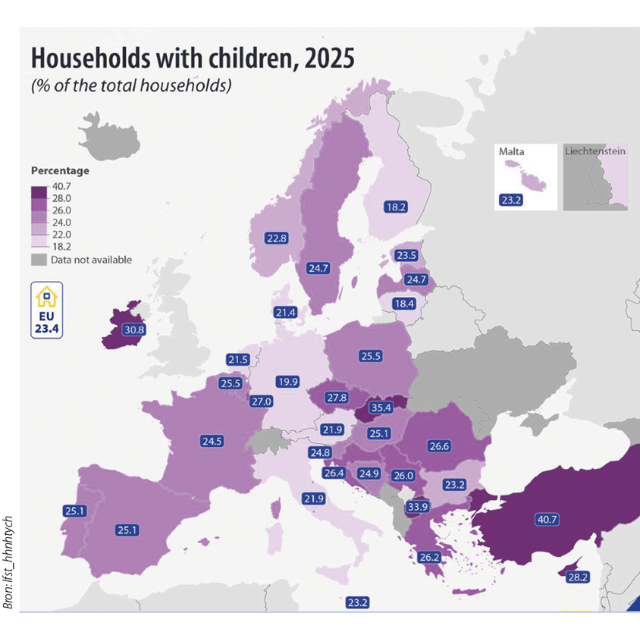
Percentage of households with children in European countries
In the Netherlands, roughly two out of every ten front doors belong to a household with children. Behind the other eight, apparently, live adults only. More than five million front doors provide access to a single-family home. But that does not necessarily mean that a family with children lives there. Why not? People move through different stages of life, and their housing situation does not always coincide with their family stage:
- young adults who are about to start a family;
- separated parents whose children live with the other parent;
- empty nesters whose children have already left the family home;
- people without children who were unfortunately unable to have them, or who chose not to have children and are happy living in a family home.
The reverse also occurs: there may be a family with children behind the front door, even though the household does not live in a single-family home.